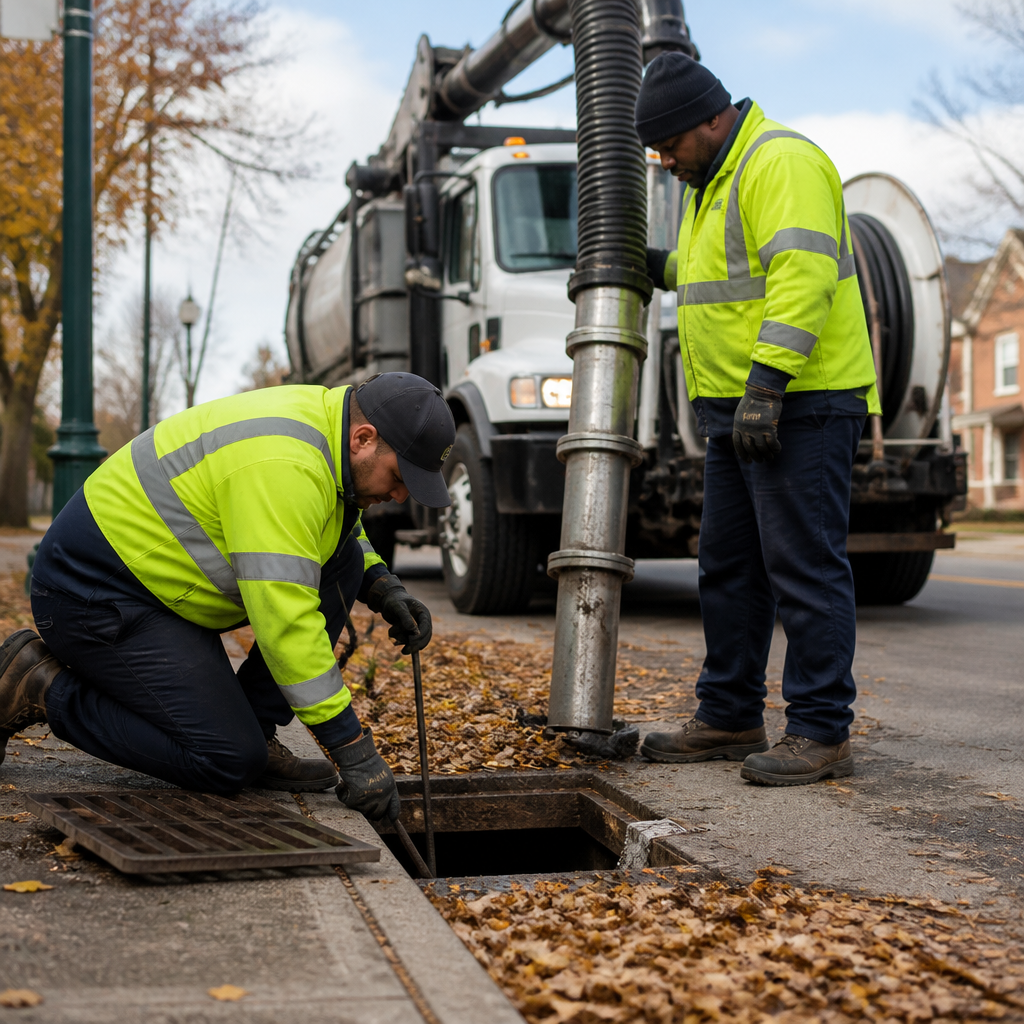

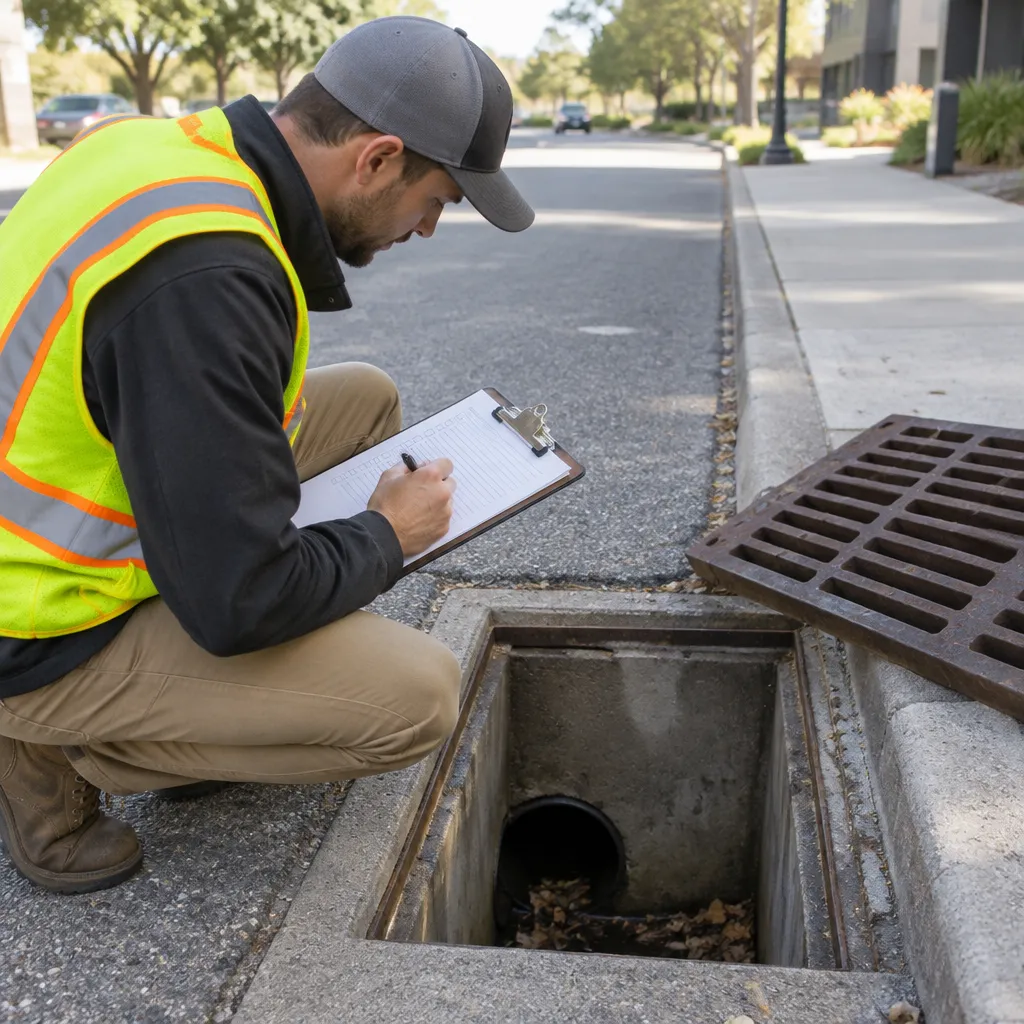
Most property owners first hear the phrase “stormwater O&M plan enforcement” when a letter arrives, not when the plan gets written. By then the inspector has usually already seen something, such as a clogged catch basin, a missing maintenance log, or a sediment trail running toward the street. Enforcement is less mysterious than it looks. It follows a predictable path of triggers, a site visit, a set of findings, and a clock for fixing them. This article walks through each stage the way our crews see it in the field, so you can spot the triggers before an inspector does.
Table of Contents
- Quick Takeaways
- What a Stormwater O&M Plan Actually Commits You To
- What Triggers an Inspection
- Records That Get Checked First
- What Happens During the Site Visit
- From Finding to Enforcement: How the Escalation Path Works
- Three Ways to Prepare for an Inspection
- Frequently Asked Questions
- References
Quick Takeaways
| Key Insight | Explanation |
|---|---|
| Complaints drive most unplanned visits | In our experience, a neighbor’s photo of a discharge or a visible sediment plume often comes before any scheduled inspection. Keep your own dated photo log so your account exists before anyone else’s. |
| Missing logs fail faster than broken structures | An inspector can cite a missing maintenance record in minutes. A repaired structure with no dated paperwork still looks like a violation on paper. |
| Short notice is normal | Some state construction programs allow inspectors to arrive with as little as 24 hours notice. Your file has to be inspection-ready all the time, not only after a phone call. |
| Corrective action deadlines are the real clock | Findings almost always come with a due date. Missing that date is what moves a site from a fix-it request toward formal enforcement, so give every finding an owner and a completion date on the day it is logged. |
| The plan must match the ground | If the plan promises quarterly cleaning and the logs show none, the mismatch becomes the finding. Update the plan whenever the site, the equipment, or the responsible party changes. |
| Respond in writing, on time, with proof | Written responses with dated photos and invoices carry more weight than verbal explanations. Keep a copy of everything you send and everything you receive. |
What a Stormwater O&M Plan Actually Commits You To
A Stormwater Operation & Maintenance (O&M) Plan is the document that states what must be maintained, who does the work, how often it happens, and what proof gets kept. Many states and municipalities now require one, and enforcement has followed the requirement. Once the O&M plan exists, every line in it becomes a promise an inspector can test.
In practice, the plan is only as strong as its match to the ground. A plan that promises quarterly catch basin cleaning but produces no cleaning receipts for two years has created its own violation. The inspector does not need to prove neglect, because the paper trail already shows it.
The components inspectors read first
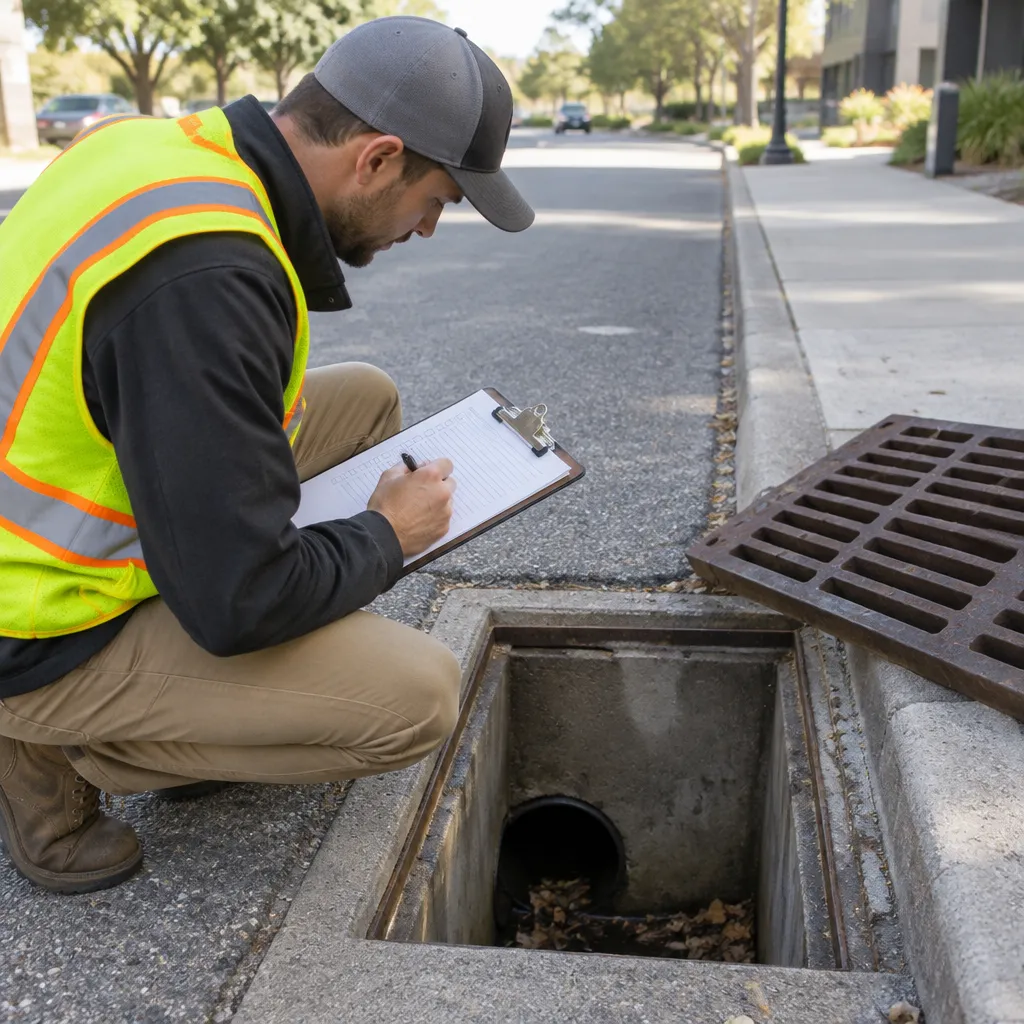
Most inspectors start with the plan itself. They look for a current site description, a list of stormwater structures and treatment devices, the maintenance frequency for each one, and the name of the person responsible. If any of those items is missing or out of date, the visit starts on the back foot.
A quick check we use in the field: each structure has an ID that matches the plan’s map, each frequency has a dated schedule, and each responsibility names a role rather than a former employee. Plans that still name a departed property manager are a common problem after an ownership change.
Why plans end up on the shelf
The IECA guide on industrial stormwater compliance makes a point we see constantly: the best written plan will not manage runoff if it is left on the shelf. The guide describes five elements every program needs: inspections, monitoring, recordkeeping, reporting, and training. That framework was written for industrial sites under NPDES permits, but the logic carries over to commercial and municipal systems.
Shelf plans usually fail at training and recordkeeping. Staff who never read the plan do not know which valves, sumps, or filters they are responsible for, and the logs stay blank. Assign one person to own the plan and review it after every major site change.
What Triggers an Inspection
Inspections rarely come out of nowhere. In our experience, they start with one of three triggers: a complaint, a scheduled routine visit, or a milestone such as a permit renewal, property transfer, or records request. Knowing which trigger is in play tells you how much time you have and what the inspector will focus on.
Stormwater runoff is regulated under the Clean Water Act through permitting systems such as the NPDES program, overseen by the EPA and state agencies. The local trigger is usually a municipal ordinance or a state permit with its own inspection schedule. One state guidance summary notes that compliance is achieved through enforcement of a stormwater management ordinance and review of site plans by each locality.
Complaints and visible discharges
A complaint is the fastest trigger. A neighbor photographs sediment running into the gutter, a passerby sees a sheen in a catch basin, or a crew notices a stained outfall after rain. Once a complaint is logged, the inspector’s first question is whether the problem is still happening.
Visible discharges carry more risk than complaints because they remove the need for the inspector to guess. Concrete washout, fuel or oil drips, and sediment tracked onto a street all count. If you control the site, respond the same day and document the cleanup with dated photos.
Scheduled routine and short-notice visits
Some programs set a fixed inspection cycle, while others leave timing to the inspector. One industry guide on preparing for state construction inspections notes that inspectors can arrive with about 24 hours notice. A file that only becomes complete after the phone call is not inspection-ready.
Under the same guide’s example permit, routine inspections happen every 7 or 14 days and within 24 hours of a runoff-producing storm, depending on jurisdiction. Post-storm walks are where small problems get caught, so build them into your routine rather than treating them as extras.
Pro tip: Put the post-storm walk on the calendar as a standing task. A short walk after each runoff event is far easier to defend than a violation letter that asks why nobody looked.
Permit milestones, transfers, and records requests
Some visits are triggered by paperwork rather than conditions. A property sale, a change of tenant or facility manager, or a municipal request for records can bring a file under review. If the O&M plan still lists the previous owner as responsible, the reviewer will notice before the site does.
Any time responsibility changes hands, update the plan, the contact list, and the maintenance contract within the same week. We treat a transfer as a compliance event, not an administrative task, and so should you.
Records That Get Checked First
When an inspector opens a maintenance file, they are checking three things: that the work happened, that it happened on schedule, and that anything wrong was fixed. Missing records are the most common stormwater compliance issue we see, and they are also the easiest to prevent. A structure that was cleaned but never logged is, on paper, a structure that was never cleaned.
The same state guide lists the basic expectations: inspection forms complete and signed by a qualified person, deficiencies documented with corrective actions and completion dates, and plan updates reflected in the narrative and maps. Those are the items to check before anyone else asks.
Maintenance logs that match the plan
A maintenance log is useful only if its entries line up with the plan’s frequencies and asset list. If the plan calls for vactor cleaning of catch basins every six months and the log shows one visit in two years, the reviewer will ask why. Explain gaps in writing when they happen, not during the inspection.
Each entry should carry a date, the technician’s name, the structure ID, the condition found, and the work performed. A tick box that says “done” with no notes is weak evidence. A note such as “sump about 60 percent full, cleaned, separator skimmed” tells a story a reviewer can trust.
Dated photos and signed inspection forms
Photos carry more weight when they are dated, show the same structure before and after, and link to a location on the plan’s map. A photo of a clean grate with no location is decoration. Keep original files with metadata intact rather than screenshots or cropped copies.
Signatures matter too. A form signed by the person who did the work, plus a qualified reviewer when your permit requires one, is the difference between a record and a draft.
Corrective action timelines
Every deficiency needs three entries: what was found, what was done, and when it was completed. Findings without completion dates look open-ended, and open-ended findings are what push a site from a fix-it request toward formal enforcement. Assign each item an owner on the day it is logged.
In enforcement files, the record usually decides the outcome more than the condition does. A poorly maintained structure with clear documentation is easier to resolve than a clean-looking one with nothing to prove it.
A practical habit is one open-items list reviewed every week. Close each item with a dated photo and a short note. That list becomes your strongest exhibit if the file is ever questioned.
What Happens During the Site Visit
A site visit is a walk, a comparison, and a conversation. The inspector checks the plan against the ground, looks at controls and structures in person, and asks who does what and where the records are. Most visits take longer than people expect, because inspectors follow the water rather than the schedule.
A state environmental agency’s construction inspection manual frames the core question directly: whether the project is causing water quality standard violations, and whether the required stormwater pollution prevention measures are in place and working. Every item you check on site should answer one of those two questions.
The walk and the controls inspectors check
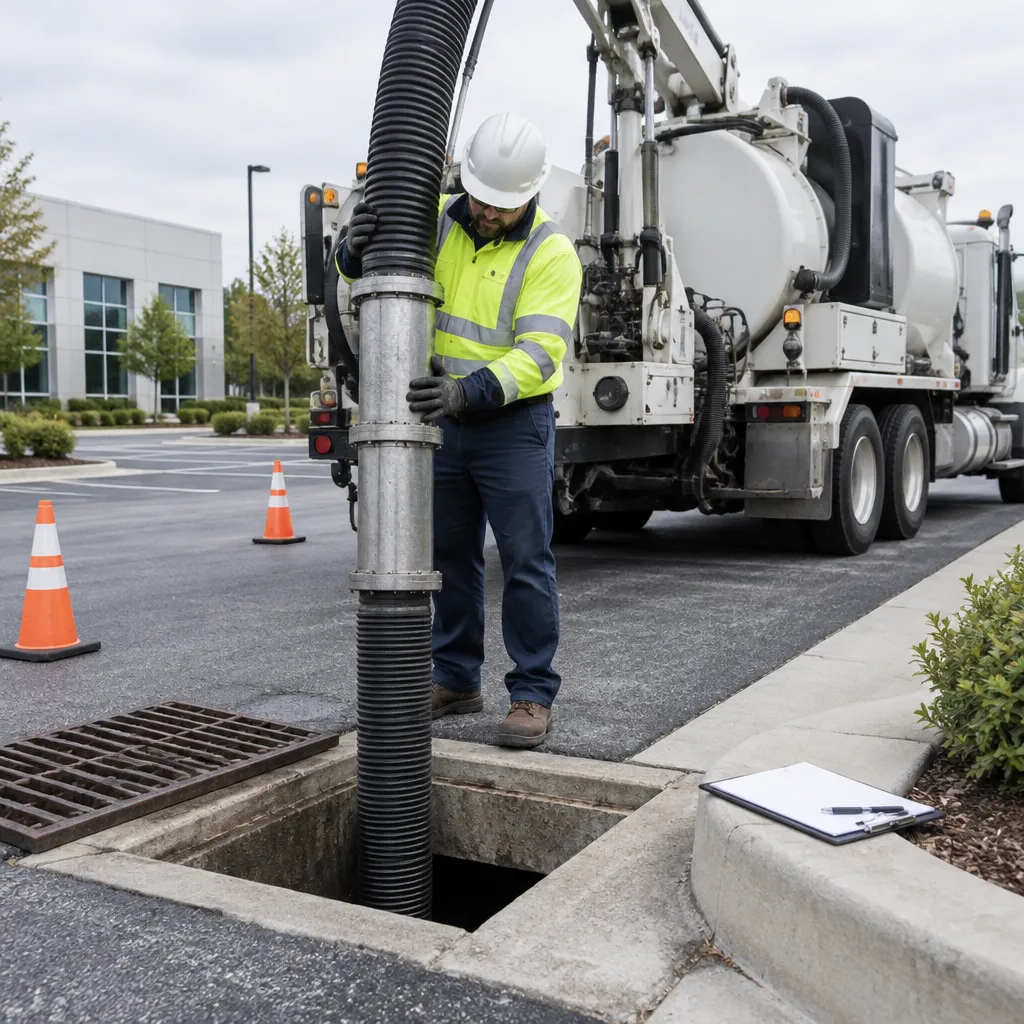
Inspectors usually start where runoff enters the system and follow it downhill. They look at erosion and sediment controls such as silt fence, wattles, inlet protection, and sediment basins. They also look for housekeeping problems like unmanaged waste, uncovered material storage, and washout areas that drain toward the street.
On commercial sites, the attention often shifts to catch basins, hydrodynamic separators, and other water quality devices. Those structures can look fine from the surface while holding a full sump below. When a visual check is not enough, CCTV pipe inspections show what is happening inside the lines.
Questions inspectors ask on site
Expect questions about the last time each device was cleaned, who did the work, and where the record is. A staff member who can answer those in under a minute keeps the visit short. Anyone who has to go looking for the binder usually creates a second visit.
Inspectors also ask about changes. If you regraded a lot, replaced a catch basin, or added pavement since the plan was written, expect to explain whether the plan still describes the site accurately.
What to do during the visit
Walk with the inspector, answer what is asked, and do not guess. If you do not know an answer, say so and commit to a dated follow-up. Take your own photos at the same time, so you hold a record of the conditions the inspector saw.
Do not argue a finding on the spot. Write it down, confirm the details, and respond in writing after you have checked your records. A calm written response usually carries more weight than a heated conversation at the curb.
From Finding to Enforcement: How the Escalation Path Works
A finding does not automatically become a penalty. Most findings start as a request to correct a condition and document the correction. Enforcement tends to follow when the correction is late, incomplete, or part of a pattern, and how you respond in the first few weeks often decides which path the file takes.
The exact steps depend on the permit and the municipality, so read the notice itself before you respond. Look for the cited requirement, the deadline, and any stated consequence. A notice that cites a specific plan section is far easier to answer than a general warning.
The notice and the first deadline
A notice usually lists the condition found, the requirement it violates, and a date for correction. Your first job is to confirm you understand the requirement before touching the work. Fixing the wrong thing on time still counts as a missed deadline in many files.
Respond in writing with what was done, when, and by whom. Attach photos and invoices where they exist. If you need more time, ask in writing before the deadline passes, not after.
When a fix-it request becomes a violation
In our experience, a finding turns into a violation when one of three things happens: the deadline passes without a response, the correction is only partial, or the same problem shows up on a later visit. Repeat findings are the clearest sign that the O&M plan is not being followed in practice.
A common mistake is treating a completed repair as the end of the matter. A replaced grate on a catch basin that never gets cleaned will fail again, and the next inspector will see the pattern in the records.
Unauthorized discharges escalate fastest
An unauthorized discharge moves quickly because pollutants leave the site, which is a different problem from a maintenance gap. Typical examples include concrete washout water, paints, fuels, oils, and sediment tracked onto roadways by vehicles. These events can expose the site to penalties beyond the original finding.
If a discharge happens, stop the source, contain the material, document the event with dated photos, and notify the responsible agency if your permit requires it. Our stormwater violation response and compliance assistance team handles this kind of file regularly. A fast, documented response is what keeps a single event from becoming a long case.
Pro tip: Keep every letter you send and every letter you receive in one folder, in date order. When a second reviewer opens the file, the sequence of events matters as much as the work itself.
Three Ways to Prepare for an Inspection
Property owners and public works departments usually choose between three ways of staying inspection-ready. Each works for some sites and fails on others. The comparison below reflects the gaps we see most often in files that come back to us after a finding.

| Approach | What It Covers | Where It Falls Short |
|---|---|---|
| In-house binder kept by facility staff | The plan on file, maintenance logs, and basic staff training for people on site | Works for simple sites with stable staff. Breaks down when the person who keeps the binder leaves, and rarely covers CCTV inspection or vactor work. |
| Maintenance contract limited to cleaning | Scheduled vactor cleaning, vacuum sweeping, and service tickets | Service tickets prove work happened but often lack condition notes, findings, or corrective action tracking, so the file is thinner than the plan requires. |
| Consultant-led program covering inspection, maintenance, and documentation | Plan review, field inspection, structure-level records, and corrective action tracking tied to the plan | Costs more up front and needs a clearly defined scope. Works best when one provider owns the plan, the field work, and the paperwork. |
The third model is the one Storm Water Compliance is built around: consult, inspect, maintain, and document under one accountable team. We have seen the same site go from a stack of unrelated service tickets to a file an inspector can review in one sitting. If your file needs that kind of consolidation, call 1-877-271-9055 or review our company background before you choose.
Frequently Asked Questions
What is the most common trigger for a stormwater inspection?
Complaints and visible discharges are the fastest triggers in our experience. Scheduled routine visits follow closely, and many permits add a post-storm inspection requirement on top of the regular cycle.
How much notice will I get before an inspector arrives?
Notice varies by program. Some state construction inspections can happen with about 24 hours notice, so plan for a visit with no advance warning and keep your records current at all times.
Do I need a stormwater O&M plan if my site is small?
That depends on your municipality and permit, so check the local ordinance first. If an inspector or agency asks for one, assume it is required and prepare it, because a missing plan is harder to explain than a short one.
How long do I have to correct a deficiency?
The deadline is set in the notice or permit, and it is the date that counts. If you cannot meet it, request an extension in writing before the date passes and explain what is being done in the meantime.
What should I do first if I receive a violation notice?
Read the cited requirement, confirm the deadline, and document current conditions with dated photos before any work starts. Then respond in writing with a clear correction plan, and bring in help early if the notice involves a discharge or repeat findings.
Can an outside provider help after a violation notice?
Yes. Our violation response and compliance assistance work covers reviewing the notice, documenting conditions, completing the required corrections, and preparing the written response, so the file shows a complete chain of action.
What trigger or inspection surprise has your team run into most often, and how did you handle the follow-up?
References
- Guide to preparing for short-notice state stormwater compliance inspections
- Guide to the five core elements of industrial stormwater program compliance
- Construction stormwater inspection manual focused on what inspectors check on site
- Summary of how state stormwater standards are enforced through local ordinances and site plan review
- Overview of Clean Water Act and NPDES permitting for stormwater runoff